"Technology is changing so quickly while the resources are limited, and the FP&A professional is being asked to deliver more insight and analysis within increasingly limited time frames. The profusion of changes demands that the FP&A professional stay abreast of the changes and be able to understand and quantify the impacts, so insightful decisions can be made." In her new article, Geetanjali Tandon, Digital Transformation Finance Director at Bayer, lists three important skills of an FP&A professional in the ever-changing business environment: https://lnkd.in/dyw2Y3J
Tuesday, June 4, 2019
FP&A Trends Blog Post: Ability to learn, unlearn and relearn - Do you need this to be successful in FP&A?
"Technology is changing so quickly while the resources are limited, and the FP&A professional is being asked to deliver more insight and analysis within increasingly limited time frames. The profusion of changes demands that the FP&A professional stay abreast of the changes and be able to understand and quantify the impacts, so insightful decisions can be made." In her new article, Geetanjali Tandon, Digital Transformation Finance Director at Bayer, lists three important skills of an FP&A professional in the ever-changing business environment: https://lnkd.in/dyw2Y3J

Monday, September 17, 2018
Targets—Do we need to set targets?
With the annual budget cycle comes the process of setting
targets. These are set for each area whether it is revenues or costs and then
trickled down to cost-center owners or functional owners. During the goal
setting process, there is constant back and forth between the bottom-up process and top-down expectations.
Even though companies have backed away from top-down goal setting, every
company gives guidance and has a strategic outlook for the growth of the organization.
On the other hand, the bottom-up process
helps us understand the needs of the functional managers who recognize the needs at the lower levels of the
organization.

But the give-and-take process between the bottom-up and top-down processes often leaves
a feeling of dissatisfaction for all parties. The managers who worked to
develop a bottom-up approach sometimes believe
that their inputs were not taken into consideration and a number was just
passed along. On the other hand, top management spends a lot of time managing
the politics between different groups and divisions and come to think that
strategic needs are not taken into consideration by the functional managers.
Target setting that has become part of the annual budget
cycle is an important exercise for any company. As stated in a Small Business
Chronicle article,[1] “Successful companies set
goals. Without them, they have no defined purpose and nothing to strive for;
consequently, they stagnate and struggle for meaningful accomplishments.” For
the goal setting to be a meaningful exercise, all parties should understand “why”
certain decisions were made and the process should be transparent.
The bottom-up process is a very
meaningful exercise to appreciate the perspective on the shop floor.
Transparency should be built at each step during a bottom-up process to understand assumptions and
the what-if scenarios. The senior managers need to know the impacts and risks
of various scenarios without cushioning the numbers. On the other hand, top
management needs to provide some high-level guidance on the overall market
expectations and guidance to help the teams below understand how decisions will
be made during the budget process.
Financial Planning and Analytics
(FP&A) teams own the annual budget and strategic planning process for companies.
Building transparency of assumptions from the bottom-up and guidance from the top-down
helps to streamline the process and reduce friction. The reconciliation and
decision-making meetings should be done in a more working-session manner with
the ability to do what-if scenarios. This would allow stakeholders to
understand the impacts of their decisions, reduce the effects of politics and
lead to more data-based decision making. Collaborative technologies, cloud-based
computing, and technologies mining big data can help streamline the target-setting
process and FP&A has a big part to play in making this process more digital,
collaborative and analytical.
Tuesday, June 26, 2018
Need for Holistic Analysis
I recently attended the 2nd series of the Greater Missouri Leadership Challenge Program in Kansas City.
During those 3 days we looked at a multitude of challenges facing the state of
Missouri as well as Kansas City and the creativity of people and organizations
trying to find solutions. One of the most impactful presentations was made by Julie
Carmichael, Director of Programs at Amethyst Place. She presented simple case
studies of how an increase in minimum pay affects the other benefits that a
family might be eligible for. There is an interconnectedness to the decisions
that may be made such that no policy or action exists in isolation. It is
imperative to understand the holistic effects of decisions. Most
importantly she did a great job of weaving a story around those numbers and
case analyses that got an immediate reaction from the audience.
Governments and communities have a lot of issues to think
about and solve for. But this presentation also got me thinking of the need for
holistic analysis for short-term and long-term projects that are brought
forward for approval within any organization. Finance plays an extremely important
role leading the organization through the decision-making process to select and
fund projects that are related to the strategic vision of the company, have
good value and balance the portfolio of long-term and short-term benefits.


But one of the most important roles that finance teams can
play is putting together the holistic story of the short-term and long-term effects
of all the various projects under consideration. This narrative needs to be expressed
to help the executive(s) understand the full impact of the decisions considered.
Every investment dollar has an opportunity cost and a risk assessment attached
to it. Financial Planning and Analysis (FP&A) professionals are in a unique
position to understand the big picture and not simply be working within the
silos of individual functions. Visually putting together the story of the
investment decisions being made not only in the current fiscal period but including
in it the ongoing impacts of decisions made previously helps to understand the whole
picture and make strategic decision-making a more meaningful exercise with
accountability and responsibility.
Here are 5 most important analytic methodolgies that need to be performed
for project selection and strategic decision-making:
- Comparison of projects: To understand that balance of the portfolio requires a qualitative as well as a quantitative comparison of projects—market-based, financial-based and resource-based—this should be done various ways. For example market share vs market growth, internal strength vs external need or threat etc.
- Risk impact: This should have two parts which would include not only what is the risk of project delivery, but also, what is the risk for the company if the project is not funded.
- Financial impacts: This should include the financial impacts of projected benefits as well as expenses in all parts of the company that are affected by a proposed project. For example, an IT project providing a new mobile customer information app may be projected to increase revenue for one department but will have an increased expense in the IT department.
- Historical information: A summary of historical projects approved, and actual benefits or expenses expected from those projects should be included in this analysis.
- Dynamic analysis of scenarios: The strategic decision-making team should be able to understand the results of its decisions in a dynamic way to make the trade-offs, understand the risks of those trade-offs in a holistic manner, and consider the impact on current decisions under consideration of previous decisions made.
With the increasing availability of different analytical
applications as well as the proliferation of data, FP&A analysts need to
transition from the narrow view of just the NPV, ROI, and payback period analyses
of projects to performing holistic analysis of financial, risk, market, and
resource impacts of decisions and trade-offs.
Wednesday, May 2, 2018
Ongoing Costs of Transformation Projects
Digital transformation is the need in every industry. Bill
Schmarzo defines digital transformation as “The application of digital capabilities
to processes, products, and assets to improve efficiency, enhance customer
value, manage risk, and uncover new monetization opportunities.” [1]
There is a lot written about how to justify the need to invest in
digital transformation and calculate the value that it will create. Funding the
digital transformation projects is essential, but CIOs and CFOs must balance
the funding needs with the returns expected.
There has not been a lot of
conversation about the ongoing costs of maintaining and upgrading transformation
projects. Digital transformation using the agile method allows small changes to
be made and brought into production quickly. The old legacy systems are not
shut down and transitioned into the new systems at once which was the old
waterfall approach. But what this means is that the company will have expenses for
legacy as well as for the new systems which leads to an increase in run
expenses for a certain time period in
addition to the cost of funding the transformation.

As a business partner to IT, finance should help IT understand the overall expense estimates for the period of transformation and beyond and message that to the business. Here are 3 points to consider while assessing and planning for ongoing expenses:
- Legacy system retirements: One of the most important questions to ask when estimating the impact of ongoing expenses of transformation is “will this new application replace an existing system/application?” In agile methods of development, parts of the old legacy systems are replaced with new applications along with providing new capabilities. But for some time, both the new application and the legacy application run side-by-side. This leads to incremental maintenance expenses during that period because IT cannot shut down the legacy systems and free up the resources. It also means help desk or service agents must be trained to service both systems and understand the capabilities provided by both applications.
- Cloud consumption: With the movement to cloud computing, investments in fixed hardware-based data centers have been replaced with ongoing cloud consumption-related expenses. Companies that are moving towards cloud computing are doing so in stages with some applications while other applications might still be in the existing data center. This means that business will see an increase in cloud consumption-related expenses but with a minimal decrease in the existing data center costs. Data already in storage in existing data centers requires investment in order to be cleaned up and moved to the cloud. This does not happen as a big-bang approach but rather the move is slow and may take years. In the meantime, the business may be growing, so the overall data-related expenses may be growing. Finance needs to work with IT to help business understand that although the per-unit cost of data might be declining, the overall data/cloud consumption may increase; thus the company will see an overall increase in cloud expenses during and after transformation.
- Infrastructure needs: An iPhone10 will not be able to perform to its capacity if it is run on a 2G network. The user will be frustrated that he or she has spent $1000 in equipment that does perform, but the problem is the network, not the equipment. With the upgrades in applications and systems and the move to cloud computing, the infrastructure of the company also requires an upgrade to keep up with the transformation. This means the company’s personal computers and networks also need continuous investment so the employees can take the full advantage of the digital transformation. And this means that there will be in increase in the pace of rising infrastructure upgrade expenses during transformation.Digital transformation is a huge change-management project. It requires a culture change within the company and support for the required investment by the investors and shareholders. But this large investment also needs a holistic funding and impact analysis with transparency around the budgets and expenses. Finance needs to partner with IT to explain both the long-term and short-term value of the investment and prepare the business on an ongoing basis for the future changes in expenses, and this will require tough decisions and prioritizations.
Monday, April 2, 2018
7 Skills You Need to be an Astute and Successful Leader in Finance
A few days
ago, Monsanto’s CFO Pierre C. took a break from his busy day, to meet and be
interviewed by 10-year old, Miles Jensen. Miles had recently played Monsanto’s
CFO at the St. Louis Junior Achievement Biztown Program; and was excited with
meet the company’s real CFO. The boy’s mother, Missy Jensen, is one of
Monsanto’s business partners at HLK agency. As an employee, I was proud to see
how Monsanto leaders truly demonstrate our values - building meaningful and
valuable relationships with business partners, that are beyond transactional.
Watch the
video for their fun interaction, including a Q&A and an entertaining Rapid
Fire.
Taking a cue from
the above, having worked in Finance for 15+ years in various industries, I am often
asked by young finance managers what the top skills are to be an astute finance
leader. So, here you go…
You have
your bachelor’s degree in finance, accounting or business and plan to pursue CPA
certification or an M.B.A. later. You interview with a few companies and have
offers from 3 companies. You consider the offers, benefits and position, and
accept the offer that seems most suitable. You are excited and eager to begin
your career and you meet some of the company’s leaders. You want to see yourself in their shoes at
some point in your career. Now you wonder—what would it take for me to be a strong
and astute leader in finance.
Here are top
7 skills you need to develop to become an influential leader in finance:
1) Nail the finance basics:
To be a leader in finance you need to become an expert in the basics of finance,
i.e. planning, forecasting, and budgeting. You should spend time in various
areas of finance and controllership such as accounting, external reporting, and
business partner finance. As a financial expert, you should be able to help your
business partners understand the financial and accounting impacts of their
decisions.
2) Understand the business: As an influential leader in finance,
you cannot work in the silos of finance and accounting. You need to understand
how the business works, so you can influence strategic business decision-making
through analytics. For this, you should spend time in various departments in the
business—whether assuming a role in the
business itself or taking on various business partner finance roles. You should
understand the company’s customers and take every opportunity to visit various
sites, meet with the customer, spend time with marketing, sales and customer
service departments. Look for the
experts in the business and make it a priority to learn and ask questions. This
would mean that you need to work outside the excel sheets and understand the
impacts of financial processes and decisions.
3) Collaborate closely with experts in
compliance and tax: Compliance
with regulatory requirements is changing dynamically and can have far-reaching impacts. These impacts are
complicated and difficult to translate into ordinary business language. Business
turns to finance to help them understand the impact of regulatory compliance
and taxation on business decisions. As a
finance leader, either you or with help from the right experts need to be able
to understand the impact and communicate what you learn in a business-friendly language.
4) Influence beyond finance: To be an influential finance leader, you need to reach out and work across functions
and departments. Business cannot make any
strategic decisions without understanding its financial impacts, and weighing the risks. In one of his articles, Joel Bernstein,
CFO of SAP’s Global Field Finance, refers to the current role of a CFO as the “internal
secretary of state” and says, “A CFO needs to think
strategically, communicate well, and interact with many different
constituencies and stakeholders—from the board to customers to investors.” To be a finance leader, you need to learn how
to communicate the story that numbers are telling, and use your influencing
skills to lead to impactful business decisions.
5) Leverage technology and automation: In today’s world, digital
transformation is the mantra for
business success. Technology is rapidly changing and affecting all businesses
and functions, including finance. An perceptive finance leader not only needs
to understand the technology used by finance, but also that used by the enterprise.
This combination will guide the strategic decisions needed for digital
transformation. There are a lot of technologies that are being developed, but a
finance leader needs to be astute as he/she prioritizes and guides investment
decisions. He/she also needs to consider the impacts of these changes on the skill
sets needed to be successful in the future finance function.
6) Be agile:
As Stephen Hawking very rightly said, “Intelligence is the ability to
change.” Change is one of the most common words used in business today. This
change can be brought by internal reorganizations or shifts in the marketplace.
To be successful in finance today, you need to be agile and develop it
as one of your strengths, to not only survive change, but also to thrive,
develop and provide guidance in changing environments.
7) Be a People Leader: People are the most
important asset in any function. A
finance function may have the latest systems, the most reliable data sources
and defined processes, but if it does not have the right people managing the
systems, analyzing the data or executing the processes, the finance function
will not perform well. To be a finance leader, you need to be able to attract,
hire, develop, and retain a highly skilled team of finance professionals that
includes a good balance of people. This team should include experts in
accounting, compliance and reporting, as well as business partners with great
planning and analysis skills.
Monday, February 26, 2018
Financial Planning for Digital Transformation
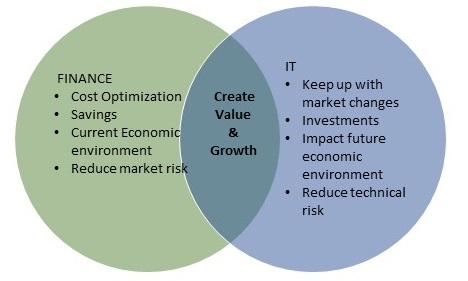
Both Finance
and IT work towards the same goals for the company—create growth and value. But
the way both functions want to achieve the goals differ, which inherently leads
to a conflict. Finance wants to control its SGA expenses and relate it to
revenue trends while IT expenses tend to follow the quickly changing technology
marketplace. But as Gartner managing vice president Barbara Gomolski said very rightly “IT (Cost Optimization) also means that
simply cutting the IT budget and waiting until the economic environment is more
favorable to make digital investments is a flawed approach to remaining
competitive.”[i]
 So how should the IT department work with finance to better plan for
its expenses. Let’s examine this in the context of top-down
and bottom-up budgeting processes. A lot has been written about both the
budgeting process and the pros and cons of it. Applying the top-down approach singularly to IT
expenses would lead to a number based on previous year trends. Adjustments will be based on revenue trends
to maintain a specific target of IT expenses as a percentage of revenue. While this process would be faster and
aligned with company goals at a high level it would miss the details and the needs
of the IT department itself. This process would also not take into
consideration the innovation and modernization investments that might be needed
in specific areas. The investments would
be dependent on the current economic environment—if the revenue trend looks
good, IT expenses might be increased and vice versa if revenue trends are not
positive. This in turn might increase
the technical and competitive risk of the company as digital investments are
becoming essential to maintaining competitiveness in any industry.
So how should the IT department work with finance to better plan for
its expenses. Let’s examine this in the context of top-down
and bottom-up budgeting processes. A lot has been written about both the
budgeting process and the pros and cons of it. Applying the top-down approach singularly to IT
expenses would lead to a number based on previous year trends. Adjustments will be based on revenue trends
to maintain a specific target of IT expenses as a percentage of revenue. While this process would be faster and
aligned with company goals at a high level it would miss the details and the needs
of the IT department itself. This process would also not take into
consideration the innovation and modernization investments that might be needed
in specific areas. The investments would
be dependent on the current economic environment—if the revenue trend looks
good, IT expenses might be increased and vice versa if revenue trends are not
positive. This in turn might increase
the technical and competitive risk of the company as digital investments are
becoming essential to maintaining competitiveness in any industry.
In a bottom-up budgeting scenario, the IT function would do
a detailed analysis of needs and put together a budget that aligns very well
with the goals of the IT function. All the participants would need to
coordinate with each other to understand the cost impacts of various projects/changes.
It would also foster the innovation and reduction of technical risks with investments
based on the changes in markets. With this
method, the IT function may be aligned internally regarding the investments but
it might not be fully aligned with the goals of the company since the company
must balance the needs for investments in IT vs. investments needed in other
functions.

To make sure budgets and financial plans are aligned across functions
and there is commitment from leadership, there must be a step of goal alignment
with budgets between the top-down and bottom-up approaches. Goal alignment
meetings should be conducted with a comparison of investments and budgets to the
goals of the company and the function to make sure that prioritization of
expense and investment is done based on the strategic goals of the company
while keeping in the mind the needs of the functions too. This prioritization exercise is imperative to
make sure the functional goals are aligned with the strategic goals of the
company and that the budgeting exercise mirrors this.
As stewards of the company’s finances, financial planning &
analytics (FP&A) analysts should guide the process of alignment of budgets
to goals and prioritization of investments within the company and functions.
FP&A should partner with business to help them make appropriate decisions regarding
the best use of limited resources based on data and analytics.
Wednesday, February 7, 2018
Going Back to the Raw Data
In finance,
we tend to report based on cost centers and categories. We combine cost centers
or cost categories and report on performance based on this. We forecast and
load based on those cost centers and cost categories. We are tied to the way we
have organized our data, and we tend to invest in projects in order to organize
our data in a different way so we can better report if the current system of organization
is not working well.

But in
the end, are we looking at and analyzing the raw data? For us in finance, the
raw data consists of our journal entries, sales, invoices, etc. How much time
are we spending looking at that raw data and making sense out of it? When we
look at reorganizing our data, do we spend time putting together rules of how
to create journal entries that make more sense so we can do data mining and
machine learning? As FP&A professionals on the cusp of harvesting the
potential of "Big Data," we must escape the view of cost centers and
cost categories and start doing deep dives into the raw data.
We have a
treasure trove of data in the current financial systems and we need to be able
to use it. As
an example, lets dive into IT expense analysis. An IT department today
in any company may be organized based on reporting structures. The function may
have decided to put all the licenses in one cost center to manage the
procurement process much better rather than by putting it in different cost
centers. So, if the company is spending money on data center, help desk or SAP
licenses—the expense for those licenses might come directly into that one cost
center. The function could have employees in one cost center working on two
different services such as data center and help desk. To help understand
the actual cost of providing data center services or help desk services, one must
pull the expenses from various cost centers and categories. One solution is to
reorganize or have more cost centers so we can track these separately, but that
can cause other issues such as inefficiencies in license management. No
one way of organizing the cost centers is perfect and needs will be changing
constantly, so to obtain any insights, we need to go back to the raw data.
Doing the
analysis on the raw data we currently have as well as connecting that data to
business drivers or operational metrics today does not require huge investments
in ERP systems. It requires more manual work of extracting the raw data and
doing the detective work. The majority of that work is done in Excel
today. This kind of manual analysis is not sustainable in the long term as it
takes time and resources and is prone to errors, but it might be the first step
to take to prove the value of such analyses. It is very important to
prove the value of the analytics needed in small pilot projects or proof of concepts
so the company can invest in the right software and tools to enable to the
analytics.
So, go
out and explore your raw data and breakout of the cost centers and cost categories.
Subscribe to:
Posts (Atom)